

Which midsize truck delivers smarter off-road tech for Menomonee Falls, WI drivers?
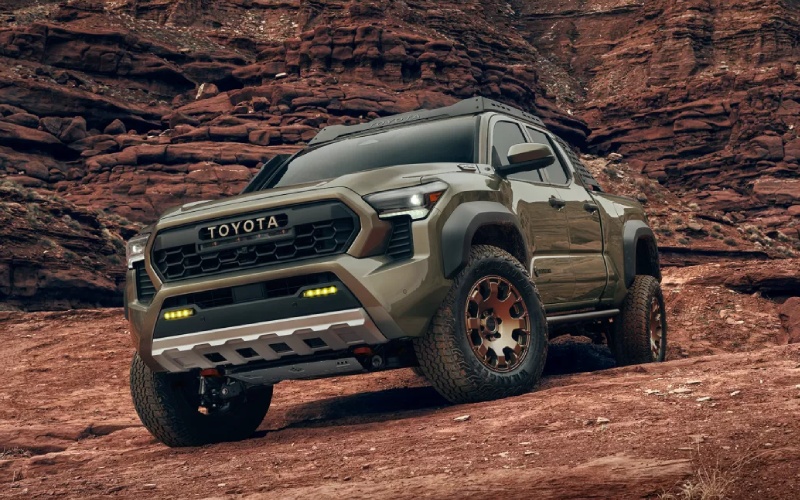
Russ Darrow Toyota – Which midsize truck delivers smarter off-road tech for Menomonee Falls, WI drivers?
When shoppers ask about the most useful off-road features in today’s midsize pickups, the question usually hides a bigger one: which truck makes tricky terrain feel easier without asking you to be a rock-crawling expert? That is where the comparison of Toyota’s trail-first design and GMC’s off-road packages gets interesting for Menomonee Falls, WI drivers. Let’s dig into the systems that matter on tight, rutted two-tracks and slick boat launches—places where a feature can feel like a true partner, not just a bullet point.
Start with traction and low-speed control. Toyota builds a suite that works together: available Crawl Control (CRAWL) acts like a low-speed cruise on loose surfaces, modulating throttle and brakes so you can focus on steering. Pair that with the available Stabilizer Disconnect Mechanism (SDM) to unlock more suspension articulation when you need it, and the truck settles into rough terrain instead of skittering across it. Then add the 3D Multi-Terrain Monitor (MTM), which lets you toggle front, side, and underbody views, including a perspective that helps you read ruts and rocks before your tires meet them.
The GMC Canyon AT4 and AT4X counter with muscle and hardware. Selectable front and rear electronic locking differentials on AT4X are serious tools, and the standard 2-inch lift (3 inches on AT4X) gives helpful clearance. Underbody cameras with multiple views can aid wheel placement when lines get tight, and drive modes adjust throttle and shift behavior for changing surfaces. It is a capable setup—especially for drivers who prefer a traditional gas-only powertrain and enjoy the clarity of locked-axle traction.
Power delivery is the next pillar. Toyota’s available i-FORCE MAX hybrid brings up to 326 horsepower and 465 lb.-ft. of torque, and the instant electric assist helps in two places off-road: stepping up a ledge where you need controlled punch, and crawling at walking speed where finesse saves your underbody. GMC’s 2.7L TurboMax at 310 horsepower and 430 lb.-ft. of torque is stout and responsive, with a torque curve that feels confident when merging or towing. The difference is in how the power hits: Tacoma’s hybrid torque is smoother right off idle, and for drivers who value precise traction on uneven surfaces, that smoothness is an advantage.
Visibility and interface matter just as much as the mechanicals. Toyota’s available 14-in. Audio Multimedia touchscreen and 12.3-in. digital gauge cluster put off-road data, trail cameras, and safety alerts in a large, easy-to-parse format. GMC’s 11.3-in. center touchscreen and 11.0-in. Driver Information Center look modern and are quick to learn, and AT4X brings a head-up display. If your priority is the largest, most customizable canvas for trail views and system status, Toyota’s screen package still has the edge.
What about drivability on the pavement leading to the trail? Toyota uniquely offers an available 6-speed manual transmission for drivers who prefer full control of gearing—helpful when descending slippery grades or easing a trailer down a ramp. The smooth 8-speed automatic pairs well with both gas and hybrid powertrains. GMC’s automatic is polished and confident, and its thick torque band makes it feel effortless in daily driving; still, if a manual matters, Toyota is the only option.
Trail durability and factory tuning are final differentiators. TRD Pro’s 2.5-in. FOX Internal Bypass QS3 shocks and the Trailhunter’s Old Man Emu 2.5-in. forged monotube shocks are engineered for distinct missions, both validated in harsh conditions. Combine that with the Trailhunter’s ARB steel rear bumper, high-clearance front bumper, and available high-mount air intake, and you are looking at an overlanding-ready build right off the lot. Canyon AT4X brings its own heavy-hitting parts catalogue, along with multiple camera views to protect underbody components. Both are thoughtfully equipped, but Toyota’s offering reads like a system rather than a collection of parts—and that cohesion shows up when trails get complicated.
For Menomonee Falls, WI drivers who split time between downtown errands and weekends around the Kettle Moraine, the question to ask is simple: which features will I actually use, and how do they work together? If your answer includes effortless low-speed control, strong yet smooth torque, and camera views that demystify tough sections, Toyota’s feature set will likely feel more natural from the first mile. If you prefer a plug-and-play gas powertrain with serious axle hardware and do not plan to use automated trail aids, GMC’s formula remains compelling.
To structure a smart test drive, consider the following quick plan.
- Map your use case: trail access, towing needs, and how much you value low-speed automation vs. mechanical lockers.
- Drive the same route: include a steep parking ramp, a tight U-turn, and a bumpy side street to sample torque delivery and ride control.
- Engage the tech: test camera views, driver aids, and any off-road modes—you will feel the software differences right away.
Below is a concise feature-to-benefit cheat sheet to bring along.
- Crawl Control: Maintains a steady low speed off-road so you can steer with less throttle-brake juggling.
- Stabilizer Disconnect Mechanism: Increases wheel travel for better grip on offset bumps and ruts.
- 3D Multi-Terrain Monitor: Shows what is ahead, beside, and underneath to prevent surprise scrapes.
- Selectable front/rear lockers: Creates direct axle drive for traction in cross-axle situations.
- High-output hybrid torque: Delivers smooth, immediate response that helps both crawling and merging.
- Large-format screens: Makes trail visuals and system data easier to read quickly.
Ready to put these systems to the test on familiar roads and trailheads? Set up a back-to-back drive and pay attention to how relaxed you feel with each truck’s aids active—confidence is the best indicator that the tech is doing its job. For a single stop that understands both the daily grind and off-road nuance, Russ Darrow Toyota brings product depth and local perspective so you can choose what truly fits your routine.
Frequently Asked Questions:
Do I need lockers if I have Crawl Control?
Crawl Control helps you modulate speed and traction automatically; lockers forcibly split power across an axle. On uneven, cross-axle terrain, lockers can be decisive, but many drivers find Crawl Control plus good tires is enough for the trails they run most.
Will a hybrid powertrain feel durable off-road?
Yes. A hybrid adds electric assist where torque matters most, at low rpm. The system is sealed and engineered for heat and dust management, and it integrates with off-road software for smooth, predictable response.
How should I compare camera systems on a test drive?
Bring the route you know. Use each truck’s underbody and surround views during tight turns, curbs, and steep entrances. Prioritize clarity, latency, and how easily you can toggle views—those differences show up fast in real-world use.
For a regional team serving Slinger, Pewaukee, and Menomonee Falls with hands-on guidance, plan your visit and test the features that matter most to your life on and off the pavement. The right truck is the one that makes hard things feel simple.
0 comment(s) so far on Which midsize truck delivers smarter off-road tech for Menomonee Falls, WI drivers?