

Which compact sedan has more advanced driver-assistance tech around Pewaukee, WI?
Russ Darrow Toyota – Which compact sedan has more advanced driver-assistance tech around Pewaukee, WI?
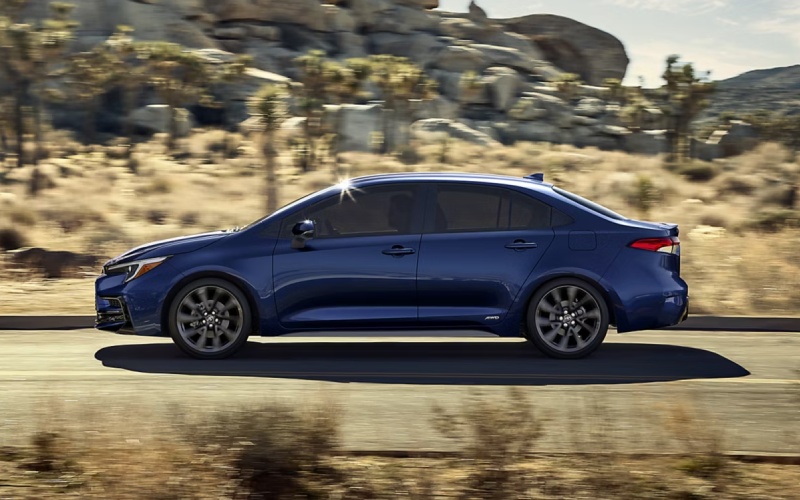
When shoppers compare the 2026 Toyota Corolla and 2026 Hyundai Elantra, one question comes up early: which compact sedan brings the stronger driver-assistance story to daily life around Pewaukee, WI? Both models pack smart features that reduce fatigue and add confidence, but there are meaningful differences in how those systems are equipped, refined, and expanded across the lineup. Below, we break down the technology that matters most when you are commuting along I-41, navigating school pick-up lines, or heading toward Kettle Moraine State Forest for a weekend drive.
Toyota equips every 2026 Corolla with Toyota Safety Sense™ 3.0. That standardization is a big deal, because it means key features like Pre-Collision System with Pedestrian Detection, Lane Tracing Assist, Full-Speed Range Dynamic Radar Cruise Control, Lane Departure Alert with Steering Assist, Automatic High Beams, and Road Sign Assist are built in from the start. On top trims, Blind Spot Monitor with Rear Cross-Traffic Alert and a 12.3-in. digital gauge cluster broaden situational awareness. The result is a low-drama driving experience: the car communicates clearly, intervenes smoothly when needed, and otherwise stays out of your way. Elantra’s Hyundai SmartSense suite is strong too—Forward Collision-Avoidance Assist, Lane Keeping Assist, and Lane Following Assist are standard. Smart Cruise Control with Stop & Go and Highway Driving Assist arrive on select trims, offering lane-centering and adaptive cruise on limited-access highways. The difference you feel comes from the Corolla’s across-the-board availability and the fine-tuning of its lane-centering and adaptive cruise behavior, which are impressively natural in traffic.
Technology is not just about safety; it is also about how easily you can see and control information. Corolla’s available 12.3-in. digital gauge cluster and 10.5-in. Toyota Audio Multimedia touchscreen present crisp, low-glare graphics, speedy responses, and natural voice control that understands conversational prompts. Wireless Apple CarPlay® and Android Auto™ are standard. Elantra counters with an easy-to-use 8-in. display on lower trims and available dual 10.25-in. screens on upper trims, plus wireless smartphone integration on the base screen. Both cars can mirror your apps, but Corolla’s interface pacing, menu logic, and voice assistant feel one step ahead in day-to-day use. On darker pre-dawn runs or snowy evenings, that clarity matters as much as the safety systems themselves.
One advanced capability worth spotlighting in Wisconsin is all-weather traction. The Corolla Hybrid offers available Electronic On-Demand All-Wheel Drive (AWD), adding rear-axle assistance during takeoff and in low-traction moments without the drag of a full-time system. Elantra does not offer AWD, regardless of trim or powertrain. Even if you only need it a few times a year, AWD support can reduce wheelspin at slick intersections and provide added composure pulling away from a curb after a plow passes—quiet, confidence-boosting help when you need it most. Pair that with the hybrid system’s low-speed smoothness and you have a small sedan that handles winter’s curveballs with an outsized sense of calm.
Audio and connectivity also shape the way you perceive safety. Clearer prompts and lower distraction can help you stay focused. Corolla’s available JBL® Premium Audio system delivers clean, full-range sound at lower volumes, so navigation prompts and alerts remain crisp even with background music. Elantra offers Bose® Premium Audio on upper trims, which is a solid upgrade. What stands out is how well Corolla’s audio tuning meshes with the voice assistant and instrument cluster cues—an integrated approach that again supports a calmer drive.
As you test-drive, try this quick routine on familiar routes: set adaptive cruise to match prevailing speeds, activate lane-centering, and glance at the cluster to see how clearly the car presents lane edges and following distance. Then, tap the voice button to adjust climate or navigation with your voice. Ask yourself whether the alerts feel reassuring, whether the car “breathes” with traffic gently, and whether the screen and cluster show information without clutter. Most shoppers tell us the Corolla’s systems simply fade into the background faster, requiring fewer mental steps to get where they want to go.
- Lane-centering feel: Corolla’s Lane Tracing Assist keeps a natural line through gentle curves without constant nudging, while Elantra’s Lane Following Assist is helpful but can feel more assertive depending on conditions.
- Adaptive cruise behavior: Toyota’s Full-Speed Range Dynamic Radar Cruise Control smoothly handles rolling traffic and quick cut-ins; Elantra’s Smart Cruise Control with Stop & Go is effective where equipped, but not available on all trims.
- Visualization: Corolla’s available 12.3-in. cluster shows lane edges, road signs, and driver-assist status with excellent contrast; Elantra’s optional 10.25-in. cluster looks sharp but does not match Corolla’s size or layout flexibility.
Bringing it together for everyday life around Pewaukee, the best driver-assistance tech is the system you trust to work the same way every drive. That means consistent equipment across trims, intuitive alerts, and an interface you can master without a manual. The 2026 Corolla checks those boxes with standard Toyota Safety Sense™ 3.0 on every model and an interface that remains smooth under hurried taps and voice commands alike. Elantra is undeniably capable, particularly in upper trims, but shoppers who want the full tech package without trim-hunting will appreciate Corolla’s straightforward value proposition.
Thinking about a hybrid? Corolla Hybrid compounds the benefits with its available Electronic On-Demand AWD, an asset for cold mornings and thaw-freeze cycles that leave side streets slick. That extra traction is not about plowing through drifts; it is about the little moments—climbing a damp driveway, easing away from a stop on a crowned road—where the car simply does what you ask with less fuss.
If you are mapping a test loop, blend a few miles of highway with a stretch of city traffic and a two-lane detour. Set both cars up the same way and pay attention to your hands and shoulders. Most shoppers notice they relax sooner in the Corolla. And when you are tuning out a long day or an early start, that ease might be the safety feature you feel most.
Ready to compare trims and features side by side? Visit Russ Darrow Toyota for a demo that highlights how these systems behave on the roads you drive most—serving Slinger, Pewaukee, and Menomonee Falls with knowledgeable guidance and an easy, no-pressure walkaround that focuses on your daily needs.
Frequently Asked Questions:
Does every 2026 Corolla include Toyota Safety Sense™ 3.0?
Yes. TSS 3.0 is standard across the Corolla lineup, bringing key features like Lane Tracing Assist, Full-Speed Range Dynamic Radar Cruise Control, and Road Sign Assist to every trim.
Can I get adaptive cruise control on a 2026 Elantra?
Yes, Smart Cruise Control with Stop & Go is available on select trims, such as SEL Sport Premium and Limited, but it is not standard across the lineup.
Which compact sedan offers AWD?
The Corolla Hybrid offers available Electronic On-Demand AWD. Elantra does not offer AWD on its gas or hybrid variants.
Which model has the larger driver display?
Corolla offers an available 12.3-in. digital gauge cluster. Elantra offers up to a 10.25-in. digital cluster.
Are both cars compatible with Apple CarPlay® and Android Auto™?
Yes. Both models support Apple CarPlay® and Android Auto™, with wireless compatibility on select screen configurations.
0 comment(s) so far on Which compact sedan has more advanced driver-assistance tech around Pewaukee, WI?